Friday, 22 November 2013

Horror


250 Word Reflective Analysis – Horror

For the creative project, my group had to create a ten shot sequence under the horror genre. Given the limited resources and practical areas to film a horror scene, my group decided to create a sequence following the preparations a killer has before he strikes at his victim.

As we were shooting the scene around the movements of the killer before he killed, we decided that the concept of time would be important throughout as it counts down how long the victim has left before the killer strikes, hence the ticking of the clock during the scene.


At the beginning, we show a door closing through low-key lighting and an oblique angle. Both of these suggest the darkness/instability of the character, which ties in well with the idea of him being a killer, making this one of m favourite shots in the scene.

Another good shot that I find interesting is the shadow against the wall of the killer sharpening his weapon. We did it this way as the only weapon like implements we had at hand was a piece of the tripod and a plastic knife – neither of which would look particularly threatening on their own.

Personally, I would have preferred for it to be shot in a better location and with a bit more time and number of shots to create a better effect in the scene, but despite that, I feel that the shots were rather creative. 

Thursday, 21 November 2013

Exploring Film Form

How does the use of sound and lighting create varying emotion in the Cabin Interrogation sequence from True Grit (2010)?

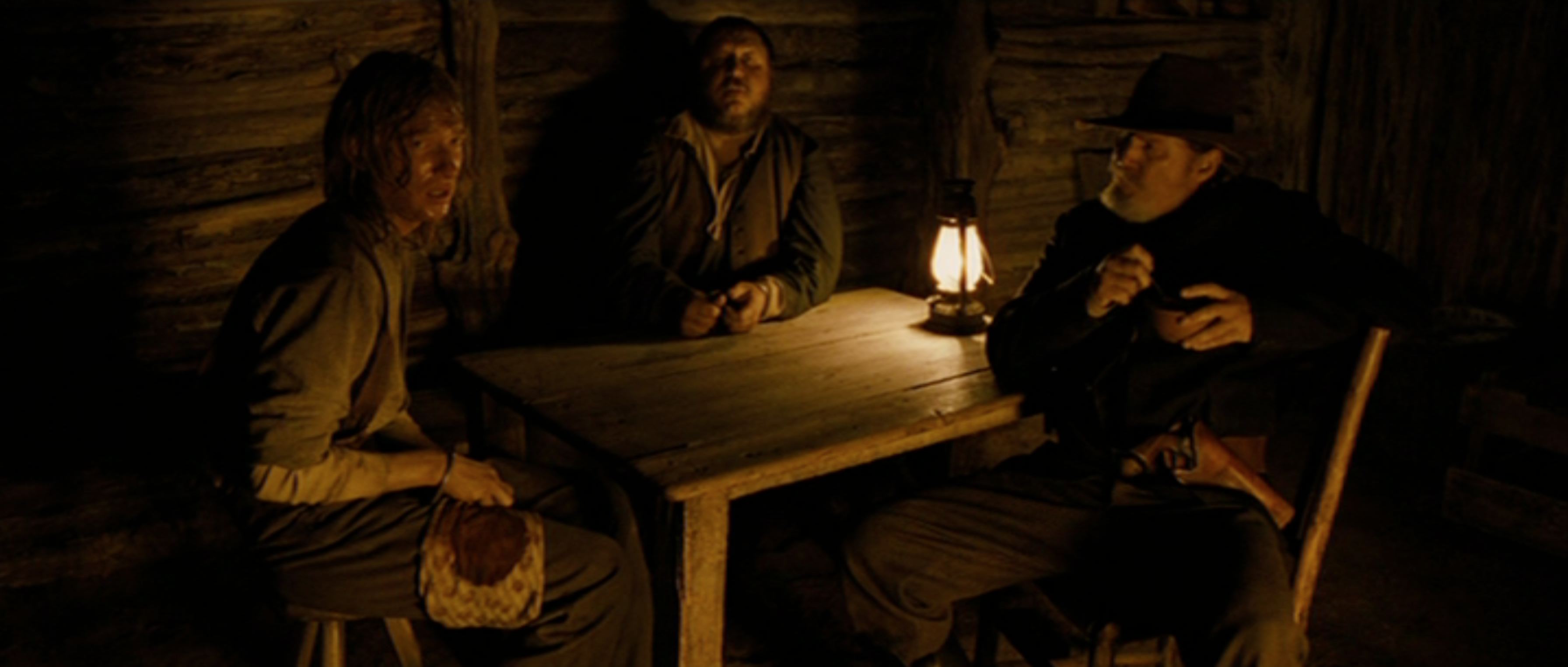
The scene from True Grit (2010) that I have chosen is the Cabin Interrogation scene. In this scene Rooster and Mattie are in a cabin with Quincy and Moon whom are handcuffed indicating that they are prisoners. To find more information about Chaney, Rooster lures Moon into telling him about Ned, who they believe to be an accomplice of Chaney, by promising to get him medical treatment for his leg before it will have to be cut off. But as Moon begins to tell them, Quincy takes a knife from his boot, and chops off Moon’s fingers before stabbing him in the chest. Rooster shoots Quincy and speaks to Moon before he dies; Moon gives Rooster information about Ned and Chaney.

True Grit falls into the western genre due to the plot behind the story, as well as the conventions that are present throughout the film. The most notable aspect of the genre are the heavy accents that the characters posses through the story; the accent is typically American in most westerns, and that has become associated with the ‘wild west’ throughout time, leading many actors to play westerns with the heavy-duty voice – this personally irritates me. This is very clear throughout the Cabin Interrogation scene as the focus is on the dialogue.

Through the Cabin Interrogation sequence, I will be looking at sound and lighting as they are both great aspects of creating emotions towards characters as well as causing tension and suspicion.

During the scene, the lighting is low key; the few parts you can see in the shots are predominately the characters faces – an example of this would be Quincy’s face after the camera tilts upward from Moon’s leg. The use of low key lighting is effective in create suspicion and tension in the scene because of what it often symbolises: suspicion, mystery, danger and concealment, coupled with the lack of sound at the beginning of the clip, except for the dialogue and the crackling of the fire, the tension in the scene mounts through the silence, before building up into music as the tension amounts towards the climax of the scene.

In ‘Super 8’ during the train crash scene, there is more diegetic (or seemingly diegetic) sound involved mostly from the train; this over abundance of sound creates tension, particularly when you hear something akin to bells, which most would consider as alarm bells ringing. This is a contrast to True Grit which uses the lack of sound, apart from the dialogue to create tension in the audience. The more apparent silence causes the viewer to feel as though something bad will happen: both Quincy and Moon attack Rooster, or the other way round. In some aspects, the lack of music, up until the point where Quincy is shouting at Moon to stop talking, foreshadows what happens at the end of the scene: Quincy and Moon’s demise.

 The lack of light has been created through placing a lantern on the wooden table and the fire in the grate that we can hear in the background of the scene, this casts a yellow flickering light on the people involved whilst causing the rest of the cabin to be in shadows. The way it shadows the rest of the cabin could also be used as a device to hint at the information and weapons that are hidden during the scene, causing the audience to be suspicious and tense as they wait for something to go wrong during the scene.

The low-key lighting used throughout the scene is not a typical western convention, which usually has high-key lighting during the film, or at the very least, neutral lighting. The audience can clearly see the difference in the conventions used in this scene, particularly if they refer back to the original True Grit film.

The picture to the right is a still from the 1969 Cabin Interrogation sequence. The original uses more neutral lighting than high-key, but it still follows the genre’s conventions. This is one of the many differences between the original and the remake.

However, whilst the directors have used the low-key lighting for effect in the remake departing from traditional conventions, they have stuck to the convention of the dialogue. The conversation during the sequence is spoken in a thick western accent, typical of Texas and similar regions, and also is spelt and phrased according to convention; the correct grammar has not been used: instead of does not (or doesn’t), the word ‘don’t’ is used.

The sound and lighting that are linked to the characters is also incredibly effective in creating emotion as the scene progresses, and they do this in different ways.

As both Quincy and Moon are handcuffed there is already an air of suspicion and perhaps danger about them, reinforced by the low key lighting and Rooster questioning them about Ned and Chaney. The lighting could also represent concealment literally and figuratively: Quincy is concealing a knife in his boot, and both are hiding information about Ned and Chaney. Whilst the lighting used is effective in implication, the non-diegetic music in the sequence, focused mostly around Quincy and Moon, is designed to invoke danger and sympathy in the audience.

When the non-diegetic music begins in the scene, just before Quincy attacks Moon, it starts off high pitched and very quiet, but as the sequence progresses, the pitch deepens to a bass note and gets louder, announcing the climax of the scene: Quincy chops off Moon’s fingers and buries a knife into his chest. After Quincy does this, Rooster shoots him; the gunshot is loud and punctuating and the music stops at this point. To me this suggests that, with the music stopping at the gunshot, that the shot is announcing the end of the attack as well as Quincy’s death. In a way, this makes the sound from the gun final, almost as if it is having the last word in the matter.

The scene is silent for a moment, before more non-diegetic music takes its place. The instruments used sound like the flute and violin; both instruments can create a calming effect on the scene, signalling the end of the scene. Another way to interpret the music is to create sympathy in the audience as Moon dies, especially as the music starts off soft but gradually gets louder as Moon gets closer to death.

Rooster and Mattie are also in low key lighting. Rooster is a dangerous man considering he is a marshal and is armed; he could easily kill them or let them go free – the idea that Quincy and Moon’s lives could be ended by this one man causes Rooster to seem very dangerous and deadly. Rooster is wearing a typical ‘cowboy hat’ that is often associated with the western genre.

This screen shot is a high angled shot from the position that Mattie appears to be in during the scene, suggesting it is a point-of-view shot from her perspective. The high angle implies that Mattie is in a position of power, and not just because she is standing: figuratively she has power over the men.

She could be seen as having power of Rooster as she is his employer; he works for her only as long as she says so. That is one idea; the next is obvious through her speech. At one point, to persuade Moon to talk, she tells him ‘I have a good lawyer at home and he will help you too’ whilst to Quincy she says ‘I don’t like you. I hope you go to jail. My lawyer will not help you’. This shows that she can easily give them a chance at freedom or completely take it away. Her power, and perhaps her danger, is suggested through the dialogue, the camera and the lighting simultaneously.

Altogether the lighting upon the characters creates a tone of suspicion/concealment as well as danger, very fitting considering it is an interrogation sequence. This technique has been similarly used in Christopher Nolan’s ‘The Dark Knight’ when the Joker had been taken into custody and placed in a dark interrogation room with only a table lamp to illuminate his face. This has been done to hide the Batman from view in the darkness until he wants to question.

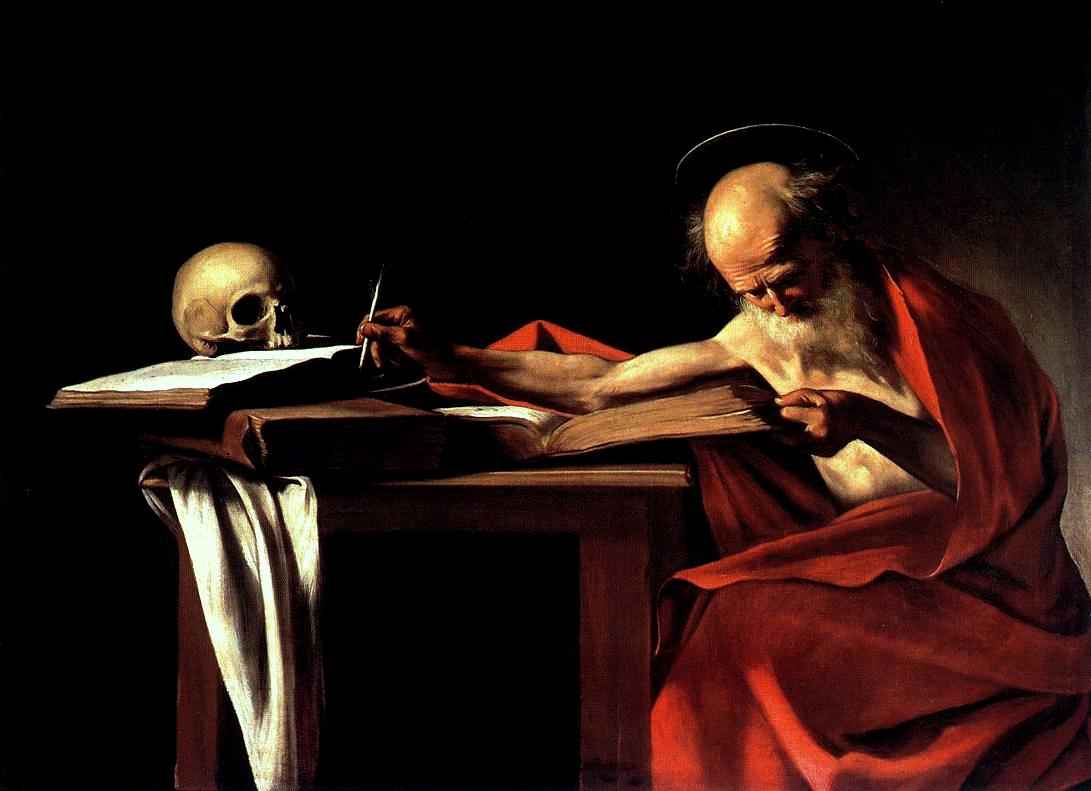
Another scene that the low-key lighting in the remake of True Grit is similar too, are the paintings of Caravaggio, an example of them is to the right (St. Jerome). Much like Caravaggio, the Coen Brothers have used a contrast of light and dark (chiaroscuro), to focus the viewer on the main features of the image: the characters. This aids in persuading the audience into paying more attention to the dialogue because of the importance later in the sequence or film.

Overall, the Cabin Interrogation scene from True Grit is effective in creating a variety of emotions – tension, suspicion, sympathy – through the use of sound and lighting, despite how they drift away from the typical conventions

Thursday, 17 October 2013

The Shining

AS Film Analysis of ‘The Shining’

The first scene of my analysis is the opening scene/credits of ‘The Shining’. Whilst there is a lack of characters and dialogue in the scene that would be relevant to the plot line, there are some horror conventions in the first scene that foreshadow the danger later in the film.

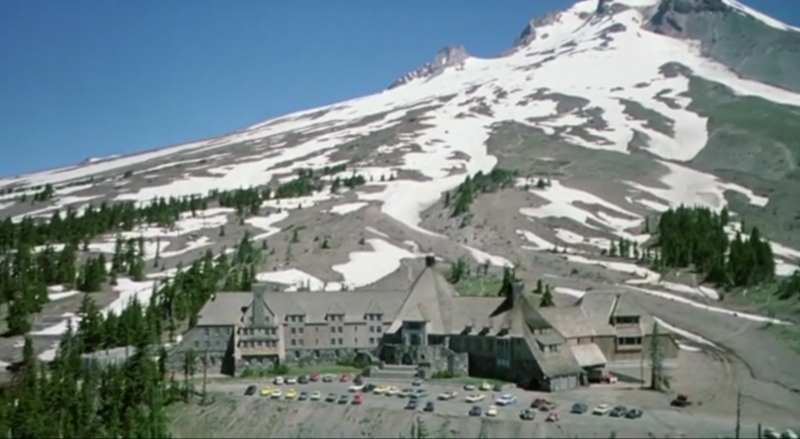
The scene for the opening credits begins by panning over a lake in a mountainous area before cutting to a birds-eye view of a car that is driving along a lonely road. The camera tracks this car continuously until it reaches the hotel at the end of the scene, indicating a long drive and a large distance from any towns or cities.

The most obvious cinematic technique in this scene is the non-diegetic sound that plays in the scene from beginning to end. At the start of the sequence the music is a deep bass which soon reveals to be a brass instrument, most likely trombone which repeats the same notes and tune a couple of times, though it does appear to vary slightly. After forty seconds into the scene, the sound increases in pitch slightly, but is beginning to be accompanied by the sound glass makes when tapped. The non-diegetic sound gets higher and higher, and is accompanied by different noise, like something akin to whispering and a distorted screaming closer to the end.

The sound itself is related to the conventions of horror due to these noises that the audience hears within the three minute scene. The deep bass of the trombone gives the viewer a sense of foreboding that generally accompanies the horror genre, and this feeling increases due to the sound of distorted screaming at the end. To me, the combination of bass and soprano used in the way it is during the opening sequence is particularly apprehensive due to the drastic variation, not to mention that the distorted screaming at the end sounds close to begging. Personally, the music alone creates a sense of anxiety which is why this scene is a brilliant opening scene to ‘The Shining’.

Another part of the scene that is also noteworthy in the way it relates to the horror conventions, as well as forewarning the viewer of the danger later on is the isolation the camera angles reveal. For the opening scene, the camera is taking the shots in birds-eye view to show the lack of cars on the road as well as the few buildings around the area, immediately the audience registers the idea that if something happens at the hotel there is no one around to help.

Despite the effective use of camera angles and sound in the opening sequence, there is a lack of iconography in the scene. In my opinion, this is due to the director trying to establish the setting and the isolation that the film revolves around.

The second scene that I am analyzing is the ‘Come play with us’ scene where Danny is riding his tricycle through the hallways of the hotel, whereupon the sinister ghost girls appear and proceed to scare Danny with images of their dead bodies.

The scene is one minute and fifty-seven seconds long and has over twice the amount of shots than in the opening scene. The first two shots track Danny down the corridor and reveal him seeing the ghost girls; the shots then proceed to cut between close ups of Danny’s expressions, and getting closer to the ghost girls as they ask him to play with them ‘Forever....and ever....and ever’. Whilst this occurs, we see the bodies of the girls three times as they suggest what will happen to him eventually.

The iconography in the scene is most prominent when the girls’ remains are shown to Danny and the audience; in the shot, there is blood on the walls and an axe lying on the floor beside the body of one of the girls. The axe itself seems to forewarn the viewer as to what choice of weapon Jack will chose to attack his family with, and as it may possibly be blunt after lack of use, the axe may seem more deadly and disturbing attack.

However, whilst the iconography with the axe is meaningful, the blood on the walls seems a bit too exaggerated. Personally, I think that the setting department got a little carried away when decorating the walls with fake blood as, while the amount on the girls is enough, the amount on the walls is too much, and it is unlikely for the blood to drip down the walls in that way as it is more likely for a slight splatter to occur when the axe is taken out of the body and swung.

Also there seems to be too little blood on the axe to be scary enough for me; this lack of realism makes it very hard to find this shot scary in my opinion, but the scene itself does disturb me.


The main reason this scene disturbs me is the idea of spooky twin ghost girls confronting you and asking you to die and play with them, added to the notion of a seemingly MPD, physic child who’s alter ego he seeks comfort from: ‘Tony, I’m scared’ ‘Remember what Mr Hallorann said. It’s just like pictures in a book Danny, it isn't real’.

Another point about this scene that disturbs me is the lighting. Generally in horror films, the lighting is usually low key, particularly when confronting or being confronted by the ghost/monster. However, in this scene, the lighting is neutral to high key, drifting away from usual horror conventions. This personally makes the scene more disturbing as it creates the sense that you could be attacked at any point during the day and not even realise it.

Altogether, the iconography, though a bit exaggerated, the shots, the characters, and the lighting makes this scene quite disturbing for me when watching as it creates a sense unease when the girls are suddenly there and then suddenly gone.

Sunday, 15 September 2013

AS Film Studies – Induction Tasks


1. Discuss why ‘The Lone Ranger’ was considered to be a box-office failure. Research and debate in a 500 word essay why this film flopped – refer to at least 5 reasons.


In the box-office world ‘The Lone Ranger’, created by Disney, is predicted to be a massive failure, with the chief reason being the genre. In this current world of film, westerns are the least popular of all the genres, despite the high numbers that have been made in the past. 

This is mainly due to a higher surge in numbers attending sci-fi, thriller/horror and animation; the world of sci-fi (such as ‘Star Trek’) is seemingly more attractive to the general community because of how close we are to achieving new heights in technology. For thriller/horror is a separate reason which is that most people like getting scared. For some the fear can often act as an adrenaline rush just like in bungee-jumping. The last genre mentioned is animation. Animation has steadily progressed from Beauty and the Beast, to Despicable Me with incredible results meaning that children, whilst being a major part of its popularity, but adults can also thoroughly enjoy the film.

This first reason about the competition between varying genres often leads to a disastrous cinematic release date, in other words, reason number two. A film with a genre that is not often appreciated fully and is released when more popular film genres are released can often bring devastating affects to the box-office income. When you compare the figures for ‘The Lone Ranger’ and ‘Despicable Me 2’ you see a vast difference in the outcome: ‘The Lone Ranger’ had a worldwide income of $239,170,894, where as ‘Despicable Me 2’ had a worldwide profit of $823,239,290. These films were both released at the same time and are of two different genres; whilst ‘Despicable Me 2’ was highly successful, ‘The Lone Ranger’ was not.

Depp said: "I think the reviews were written seven to eight months before we released the film. [The critics] had expectations that it must be a blockbuster. I don't have any expectations of that. I never do." (Source: Catherine Shoard, The Gaurdian) From Johnny Depp’s comment about critics expecting it to be a blockbuster when in reality it’s not, caused the film to be hyped up by prospective viewers and also criticised in the way a blockbuster would have been. Through this, it is safe to assume that the criticism involved caused few people to want to see the film.
 

Disney is a film company that is often associated with children and family orientated films like ‘Alice in Wonderland’ and ‘Pirates of the Caribbean’, both of which are fantasy based. Through watching the trailer alone, it is clear that ‘The Lone Ranger’ is in a different league; there is a clear amount of violence (which could possibly lead to a minor amount of gore) and for younger viewers it may not appeal to them nor would their parents want them to be exposed to it. Through this it is less appealing to the general audience associated with Disney.

Lastly is the advertising for the story. The Lone Ranger’ film is an adaptation of a Detroit radio character in the 1930s and a TV series in the 1950s, but despite its previous versions, there is a lack of awareness, particularly in the younger populace. In comparison, super hero comics (Superman, Captain America etc) which have been around for generations are known globally and are kept alive by a great number of people. With a lack of people knowing the story of ‘The Lone Ranger’ and a limited amount of advertising that Disney made, few people would have recognised its origins and would have been less excited to see it.


2. What was your favourite film this summer? Write a 500 word ‘personal response’ stating why you enjoyed it.


Over the summer my favourite film has to be J.J.Abrams ‘Star Trek: Into Darkness’. With the original ‘Star Trek’ series being popular in its day and the various spin-offs (‘Voyager, Enterprise, Next Generation’) it would have been a real challenge for the director, J.J.Abrams, to live up to and surpass the ingenuity of the numerous series which, in my personal opinion, Abrams did in the 2009 release of ‘Star Trek’. The special affects and technology would have been designed specifically to introduce the cleanliness that is often associated with the future and is pulled off in the first ‘Star Trek’ film.

The back story for both films is that it is an alternative universe compared to the original series, which is said to be the universe in which Ambassador Spock is from (the older one). With this in mind, Abrams could look to the stories in the original series and use them to inspire his films effectively – for example, ‘Into Darkness’ is based upon the ‘Wrath of Kahn’. Whilst there are changes to the story, it allows Abrams to attract an audience of not just the younger generations, but also the older as they would remember watching the original series when they were younger.

However, despite this advantage of using the original series plots as a basis for the films, it means that Abrams had little room for deviations from the ‘Star Trek’ theme. This is a comparison to ‘Super 8’, a film which allowed Abrams a greater freedom with the story line along with the technology of the time period, but in my opinion, ‘Super 8’, as ingenious as it was, is not as good in comparison to ‘Star Trek: Into Darkness’, despite the limitations Abrams had to put up with whilst filming.

The actors are another one of the reasons I enjoyed the film. They portrayed their characters brilliantly and effectively changing the tone when necessary. Chris Pine plays Captain Kirk spectacularly; he is able to show the stubborn headed, arrogant profile he generally flaunts as well as the part of the character that shows responsibility, courage and an interest more to his crew’s health and well-being than his own. Another great example of incredible acting is with Benedict Cumberbatch as he plays his character Kahn. Kahn is shown by Cumberbatch as a sinister character with nothing left to lose (ultimately making him the most dangerous enemy) a long with being better at everything than most people: he is stronger, smarter, and more capable turning him into a deadly weapon. 

Overall, ‘Star Trek: Into Darkness’ is a clever film assorted with action, adventure and enough sci-fi involvement to keep a large portion entertained and happy with the film and how the plot progresses. The clever combination of actors who are capable of portraying the character described, shows that the directors and producers thought long and hard of how to make this film as best as it could possibly be. Couple these accomplishments with the smart use of CGI for the exterior shots of the star ships in a way that looks realistic and the result is a film that could be portrayed as a masterpiece.