How does the use of sound and lighting
create varying emotion in the Cabin
Interrogation sequence from True Grit
(2010)?
The scene from True
Grit (2010) that I have chosen is the Cabin
Interrogation scene. In this scene Rooster and Mattie are in a cabin with Quincy
and Moon whom are handcuffed
indicating that they are prisoners. To find more information about Chaney, Rooster lures Moon into
telling him about Ned, who they
believe to be an accomplice of Chaney,
by promising to get him medical treatment for his leg before it will have to be
cut off. But as Moon begins to tell
them, Quincy takes a knife from his
boot, and chops off Moon’s fingers
before stabbing him in the chest. Rooster
shoots Quincy and speaks to Moon before he dies; Moon gives Rooster information about Ned
and Chaney.
True Grit falls into
the western genre due to the plot behind the story, as well as the conventions
that are present throughout the film. The most notable aspect of the genre are
the heavy accents that the characters posses through the story; the accent is
typically American in most westerns, and that has become associated with the ‘wild west’
throughout time, leading many actors to play westerns with the heavy-duty voice
– this personally irritates me. This is very clear throughout the Cabin Interrogation scene as the focus is on the dialogue.
Through the Cabin Interrogation sequence, I will be
looking at sound and lighting as they are both great aspects of creating
emotions towards characters as well as causing tension and suspicion.
 During the
scene, the lighting is low key; the few parts you can see in the shots are
predominately the characters faces – an example of this would be Quincy’s face after the camera tilts upward
from Moon’s leg. The use of low key
lighting is effective in create suspicion and tension in the scene because of
what it often symbolises: suspicion, mystery, danger and concealment, coupled
with the lack of sound at the beginning of the clip, except for the dialogue
and the crackling of the fire, the tension in the scene mounts through the silence,
before building up into music as the tension amounts towards the climax of the
scene.
During the
scene, the lighting is low key; the few parts you can see in the shots are
predominately the characters faces – an example of this would be Quincy’s face after the camera tilts upward
from Moon’s leg. The use of low key
lighting is effective in create suspicion and tension in the scene because of
what it often symbolises: suspicion, mystery, danger and concealment, coupled
with the lack of sound at the beginning of the clip, except for the dialogue
and the crackling of the fire, the tension in the scene mounts through the silence,
before building up into music as the tension amounts towards the climax of the
scene.
In ‘Super 8’ during
the train crash scene, there is more diegetic (or seemingly diegetic) sound
involved mostly from the train; this over abundance of sound creates tension,
particularly when you hear something akin to bells, which most would consider
as alarm bells ringing. This is a contrast to True Grit which uses the lack of sound, apart from the dialogue to
create tension in the audience. The more apparent silence causes the viewer to
feel as though something bad will happen: both Quincy and Moon attack Rooster, or the other way round. In some
aspects, the lack of music, up until the point where Quincy is shouting at Moon
to stop talking, foreshadows what happens at the end of the scene: Quincy and Moon’s demise.
The lack of light has
been created through placing a lantern on the wooden table and the fire in the
grate that we can hear in the background of the scene, this casts a yellow
flickering light on the people involved whilst causing the rest of the cabin to
be in shadows. The way it shadows the rest of the cabin could also be used as a
device to hint at the information and weapons that are hidden during the scene,
causing the audience to be suspicious and tense as they wait for something to
go wrong during the scene.
 The low-key lighting used throughout the scene is not a
typical western convention, which usually has high-key lighting during the
film, or at the very least, neutral lighting. The audience can clearly see the
difference in the conventions used in this scene, particularly if they refer
back to the original True Grit film.
The low-key lighting used throughout the scene is not a
typical western convention, which usually has high-key lighting during the
film, or at the very least, neutral lighting. The audience can clearly see the
difference in the conventions used in this scene, particularly if they refer
back to the original True Grit film.
The picture
to the right is a still from the 1969 Cabin
Interrogation sequence. The original uses more neutral lighting than
high-key, but it still follows the genre’s conventions. This is one of the many
differences between the original and the remake.
However, whilst the directors have used the low-key lighting
for effect in the remake departing from traditional conventions, they have
stuck to the convention of the dialogue. The conversation during the sequence
is spoken in a thick western accent, typical of Texas and similar regions, and
also is spelt and phrased according to convention; the correct grammar has not
been used: instead of does not (or doesn’t), the word ‘don’t’ is used.
The sound and lighting that are linked to the characters is
also incredibly effective in creating emotion as the scene progresses, and they
do this in different ways.
As both Quincy and Moon are handcuffed there is already an
air of suspicion and perhaps danger about them, reinforced by the low key
lighting and Rooster questioning them
about Ned and Chaney. The lighting could also represent concealment literally and
figuratively: Quincy is concealing a
knife in his boot, and both are hiding information about Ned and Chaney. Whilst
the lighting used is effective in implication, the non-diegetic music in the
sequence, focused mostly around Quincy
and Moon, is designed to invoke danger
and sympathy in the audience.
When the non-diegetic music begins in the scene, just before Quincy attacks Moon, it starts off high pitched and very quiet, but as the
sequence progresses, the pitch deepens to a bass note and gets louder,
announcing the climax of the scene: Quincy
chops off Moon’s fingers and buries a
knife into his chest. After Quincy
does this, Rooster shoots him; the
gunshot is loud and punctuating and the music stops at this point. To me this
suggests that, with the music stopping at the gunshot, that the shot is
announcing the end of the attack as well as Quincy’s
death. In a way, this makes the sound from the gun final, almost as if it
is having the last word in the matter.
The scene is silent for a moment, before more non-diegetic
music takes its place. The instruments used sound like the flute and violin;
both instruments can create a calming effect on the scene, signalling the end
of the scene. Another way to interpret the music is to create sympathy in the
audience as Moon dies, especially as
the music starts off soft but gradually gets louder as Moon gets closer to death.
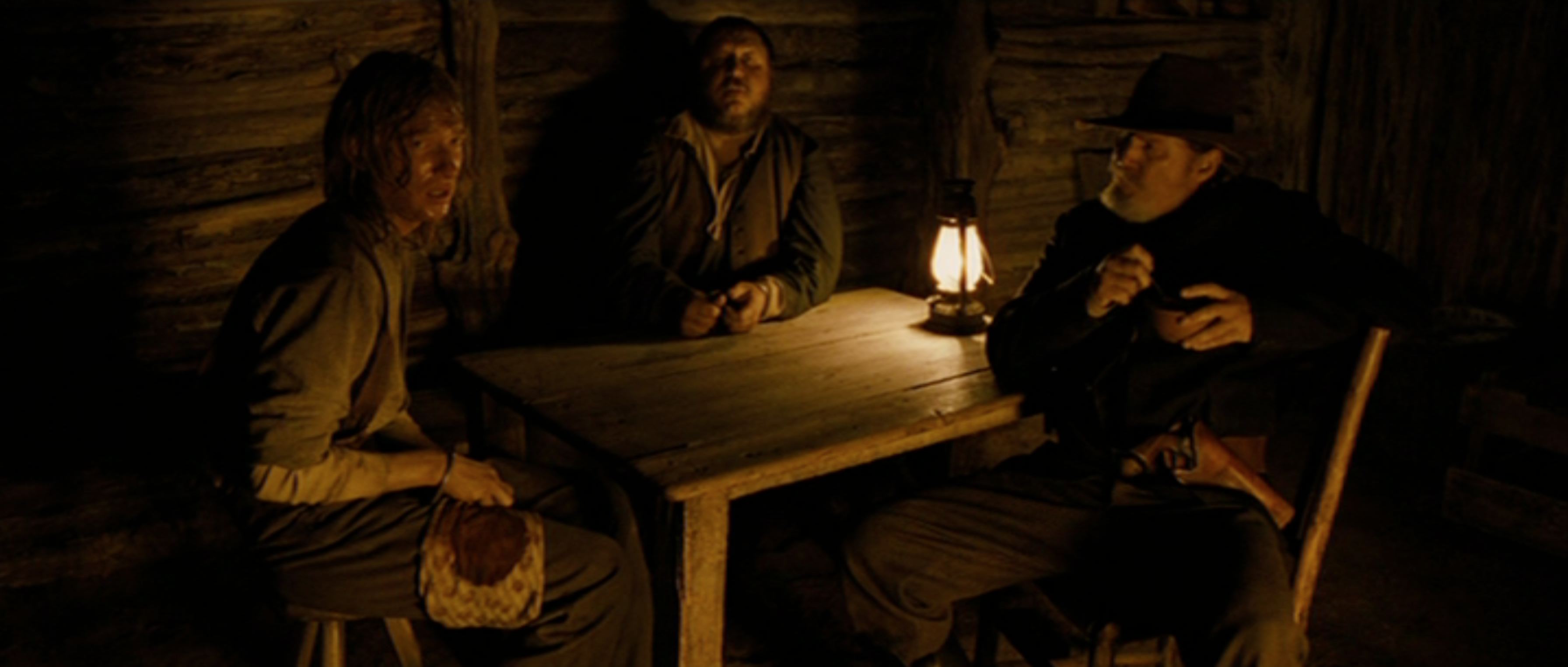 Rooster and Mattie are
also in low key lighting. Rooster is
a dangerous man considering he is a marshal and is armed; he could easily kill
them or let them go free – the idea that Quincy
and Moon’s lives could be ended by
this one man causes Rooster to seem
very dangerous and deadly. Rooster is
wearing a typical ‘cowboy hat’ that is often associated with the western genre.
Rooster and Mattie are
also in low key lighting. Rooster is
a dangerous man considering he is a marshal and is armed; he could easily kill
them or let them go free – the idea that Quincy
and Moon’s lives could be ended by
this one man causes Rooster to seem
very dangerous and deadly. Rooster is
wearing a typical ‘cowboy hat’ that is often associated with the western genre.
This screen shot is a high angled shot from the position that
Mattie appears to be in during the
scene, suggesting it is a point-of-view shot from her perspective. The high
angle implies that Mattie is in a position
of power, and not just because she is standing: figuratively she has power over
the men.
She could be seen as having power of Rooster as she is his employer; he works for her only as long as
she says so. That is one idea; the next is obvious through her speech. At one
point, to persuade Moon to talk, she
tells him ‘I have a good lawyer at home
and he will help you too’ whilst to Quincy
she says ‘I don’t like you. I hope you go
to jail. My lawyer will not help you’. This shows that she can easily give
them a chance at freedom or completely take it away. Her power, and perhaps her
danger, is suggested through the dialogue, the camera and the lighting
simultaneously.
Altogether the lighting upon the characters creates a
tone of suspicion/concealment as well as danger, very fitting considering it is
an interrogation sequence. This technique has been similarly used in
Christopher Nolan’s ‘The Dark Knight’
when the Joker had been taken into
custody and placed in a dark interrogation room with only a table lamp to
illuminate his face. This has been done to hide the Batman from view in the darkness until he wants to question.
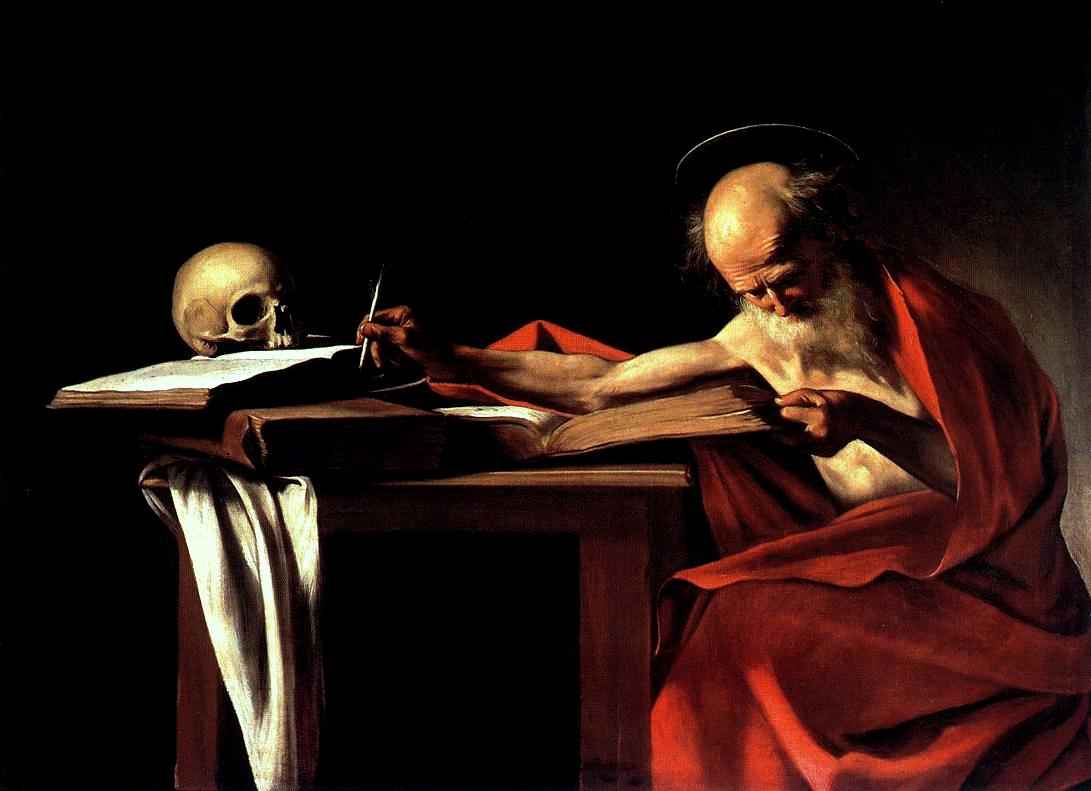
Another scene that the low-key lighting in the remake of True Grit is similar too, are the
paintings of Caravaggio, an example of them is to the right (St. Jerome). Much like Caravaggio, the
Coen Brothers have used a contrast of light and dark (chiaroscuro), to focus
the viewer on the main features of the image: the characters. This aids in
persuading the audience into paying more attention to the dialogue because of
the importance later in the sequence or film.

No comments:
Post a Comment